

Can Foreign Workers in Canada Study Without a Study Permit? The September 2026 Policy Explained
As of September 4, 2026, eligible foreign workers in Canada can study for up to six months without obtaining a separate study permit, thanks to a new temporary public policy. If you hold a valid work permit and your course or program doesn’t exceed six months, you’re free to enroll and pursue education alongside your employment with no additional authorization required.
This exemption simplifies a path that thousands of temporary workers have long sought: the ability to upskill, complete professional certifications, or pivot careers without navigating the traditional study permit process. Previously, work permit holders faced bureaucratic hurdles and processing delays even for short courses designed to enhance their qualifications. The new policy removes those barriers entirely, and it applies nationwide, including Quebec, where workers can now study without the Quebec Acceptance Certificate that MIFI typically requires.
The change reflects Canada’s recognition that workers and the economy both benefit when foreign talent can adapt and grow without red tape. For a software developer taking a three-month cybersecurity bootcamp, a healthcare aide completing a nursing skills upgrade, or a trades worker pursuing safety certification, the exemption means one less application, one less fee, and weeks saved. Learning institutions may ask you to prove your eligibility, but there are no special conditions tied to your work permit. You simply need to ensure your program fits within the six-month window.
This article walks through exactly who qualifies, how the exemption works in practice, and what documentation you’ll need to show your school. We’ll also explore real stories of workers who’ve used similar pathways to transform their careers and strengthen their communities, illustrating how education access fuels both individual mobility and broader sustainability in immigration policy.
What the September 2026 Policy Changes
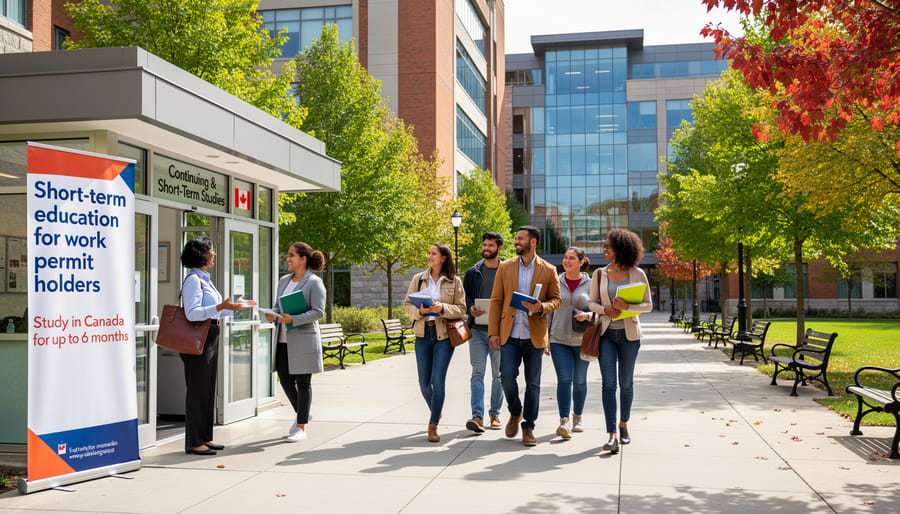
On September 4, 2026, Immigration, Refugees and Citizenship Canada introduced a temporary policy from Sept. 4, 2026 that removes a longstanding administrative hurdle for foreign workers already contributing to the Canadian economy. Under this measure, individuals holding valid work permits can enrol in educational programs lasting six months or less without applying for a separate study permit. The change targets workers who want to upgrade their skills, learn new trades, or complete professional certifications while employed in Canada.
This isn’t about students seeking work authorization. It’s the reverse: foreign workers already authorized to work in Canada can now pursue short-term education without navigating a second immigration process. Previously, even a brief technical course or language program required a study permit application, creating delays and costs that discouraged skill development. The new framework recognizes that upskilling benefits both the worker and the Canadian labour market, particularly in sectors transitioning toward sustainability and green technology.
The policy matters because it treats workforce development as integral to successful immigration. Workers can respond quickly to industry changes, pursue certifications in renewable energy or sustainable construction, or strengthen their official language proficiency without waiting months for permits. For employers, it means greater workforce adaptability. For communities, it supports immigrant integration by enabling education access that aligns with local economic needs and environmental goals, building a more resilient, skilled population equipped to address Canada’s climate and infrastructure challenges.
Who Is Eligible to Study Without a Study Permit
Quebec-Specific Provisions
For work permit holders in Quebec, the September 2026 policy delivers a double administrative win: you can now study without obtaining either a federal study permit or a Quebec Acceptance Certificate (CAQ) from the Ministère de l’Immigration, de la Francisation et de l’Intégration (MIFI). Previously, Quebec-based workers faced dual requirements that made short-term education cumbersome and time-consuming.
This streamlined access matters especially for francophone integration programs and skills training targeted at newcomers. A temporary foreign worker employed in Montreal, for instance, can now enroll in a four-month French-language intensive or a welding certification course without navigating two separate government approval processes. The policy removes friction from exactly the kind of short-term learning that supports workforce retention and community participation.
When you meet the core eligibility criteria, a valid work permit and a program six months or less, both federal and provincial barriers disappear. Your learning institution may request proof of your valid work permit and confirmation that your program fits the duration requirement, but no formal applications to immigration authorities are necessary. This practical change opens doors for thousands of Quebec workers who want to upskill, integrate linguistically, or pursue specialized training without bureaucratic delay.
How to Use This Exemption: Practical Steps

Accessing education under the September 2026 exemption is straightforward because no formal application is required. Foreign workers who meet the eligibility criteria can enroll directly in programs lasting 6 months or less without submitting any paperwork to Immigration, Refugees and Citizenship Canada for a study permit. The exemption removes both the application process and the need to meet any study-related conditions that might appear on your work permit.
- Confirm your eligibility by checking that you hold a valid work permit and that the program you want to take is 6 months or less in duration.
- Choose your program and contact the learning institution to inquire about enrollment requirements, as institutions set their own admission criteria independent of immigration policy.
- Prepare documentation showing your valid work permit and the program’s duration, as proof of eligibility may be requested by the school during the enrollment process.
- If you’re working in Quebec and plan to study there, note that you don’t need a Quebec Acceptance Certificate (CAQ) from MIFI under this temporary policy.
- Enroll in the program and keep a copy of your work permit and program details readily accessible in case immigration officials ask to verify your status.
The exemption applies whether you study full-time or part-time, and you aren’t required to notify immigration authorities that you’ve started studying. Your primary responsibility remains maintaining valid work permit status while pursuing education that supports your career development in Canada.
Real-World Impact: Who Benefits and How

A Construction Worker’s Path to Green Building Certification
Maria Rodriguez arrived in Toronto in early 2025 on a two-year work permit, hired as a formwork carpenter for a mid-rise residential project. By spring 2026, she’d noticed growing demand for workers who understood passive house design and low-carbon concrete techniques, skills her employer needed but couldn’t easily source. When the September 4 temporary policy took effect, Maria enrolled in a 16-week green building fundamentals course at a local trades college, covering energy modelling, sustainable material selection, and LEED certification principles.
Because the program ran under four months, she didn’t need a study permit. Her employer adjusted her schedule to part-time hours during the course, and Maria kept her work permit status throughout. The college asked for a copy of her valid work permit and confirmation the program was under six months; she provided both in a single email.
Three months later, Maria returned to full-time work with credentials her contractor could bill at a premium rate on net-zero construction bids. Her new skills positioned her for permanent residency pathways tied to skilled trades, and she now mentors other newcomers exploring similar upskilling routes. The policy’s flexibility turned what might have been a bureaucratic detour into a straightforward career investment, aligning her goals with Canada’s push for a low-carbon building sector.
What This Policy Means for Canada’s Sustainability and Immigration Goals
Removing educational barriers for foreign workers delivers tangible sustainability benefits for Canada. When work permit holders can upskill quickly without navigating permit bureaucracy, they become more adaptable to evolving labour market demands, particularly in sectors driving climate action. A construction worker who takes a four-month green building course or a hospitality employee who enrols in a sustainability management certificate can immediately apply new knowledge in their workplace, accelerating Canada’s transition to a low-carbon economy without waiting months for study permit processing.
This policy also reduces administrative burden across the immigration system, freeing resources that can support other pathways like temporary workers PR applications. Less paperwork means faster access to the skills Canada needs now, from renewable energy technicians to circular economy specialists. Workers gain competitive advantages that strengthen their long-term prospects, while employers benefit from a more qualified, responsive workforce without sponsoring additional permits.
Beyond economics, this flexibility fosters inclusive communities. Official language training, cultural competency courses, and environmental certifications become accessible to workers who might otherwise delay their professional development. When immigrants can grow their skills while contributing to the workforce, they integrate more fully into Canadian society and anchor their futures here. The policy treats foreign workers as valued contributors rather than temporary fixtures, aligning with principles of equitable immigration that recognize human potential beyond visa categories.
Workforce adaptability and reduced red tape aren’t just administrative wins, they’re foundational to building resilient, sustainable communities where people and planet both thrive.
Frequently Asked Questions
Can I study full-time or part-time under this exemption?
Yes, you can enroll in either full-time or part-time programs. The policy doesn’t restrict your study intensity, it only requires that the program duration is six months or less and that you hold a valid work permit.
What happens if my program exceeds six months?
If your course of study runs longer than six months, you’ll need to apply for a study permit before you begin. The exemption applies only for programs under 6 months, so enrolling in a seven-month program without a permit would violate immigration rules.
Do I need to inform immigration authorities before I start studying?
No, you don’t need to notify IRCC or apply for special permission. However, keep your valid work permit and proof of your program’s duration readily available, as your learning institution may request confirmation of your eligibility.
Can my spouse or dependent children study under this policy?
No, this temporary measure applies only to individuals who hold a valid work permit. Family members would need their own study permits unless they separately qualify for an exemption under different provisions.
Beyond these common scenarios, keep in mind that eligibility rules can evolve. If you’re planning educational upgrades that might improve your immigration prospects, perhaps to boost your CRS calculator score or align with sector-specific worker mobility agreements verify the program length and your work permit validity before you enroll. Maintaining documentation of both will streamline any future interactions with educational institutions or immigration officials.
The September 2026 temporary policy marks a practical shift in how Canada supports foreign workers already contributing to the economy. By removing the study permit requirement for programs six months or less, it clears a path for workers to build skills, learn languages, or pursue certifications without navigating separate immigration applications. This flexibility strengthens both individual career trajectories and Canada’s broader sustainability goals, from green building trades to environmental technology.
If you hold a valid work permit, you’re now free to enroll in eligible programs that align with your professional ambitions and the country’s climate priorities. Whether you’re looking to understand the difference between a permit vs visitor record or planning your next credential, the administrative burden has lightened. Take advantage of this window to invest in your future while contributing to a more resilient, inclusive Canada.
